
The Ultimate Guide to Custom Spring Fabrication with Tennessee Spring & Metal
By Paul Benny, CEO Tennessee Spring & Metal
Table of Contents
What Is Custom Spring Fabrication?
Why Choose a Custom Spring vs. Off-the-Shelf
Common Spring Types & Applications
Materials and Wire Choices
Design Considerations & Engineering Collaboration
Manufacturing Processes & Capabilities
Secondary Operations, Finishes & Testing
Quality Assurance, Traceability, and Certifications
Tennessee Spring & Metal: Why Partner with Us
How to Request a Custom Spring Quote
FAQs
Chapter 1: Custom Spring Fabrication
For industries ranging from automotive to agricultural, attic ladder to overhead doors, and food manufacturing to medical equipment, spring components and custom metal-formed parts play a vital role in performance, durability, and safety.
However, “off-the-shelf” springs often fall short of meeting exact tolerances, load requirements, space constraints, or life-cycle expectations. That’s where our custom spring fabrication comes in. Our team works with our customers to design, test, and produce springs tailored to your application’s specific needs.
At Tennessee Spring & Metal, we combine decades of expertise, in-house engineering, rigorous quality processes, and a wide suite of finishes and coatings to deliver custom springs and metal formed parts you can trust.
In this guide, we'll walk you through every critical step — from concept to delivery — and explain why working with a dedicated custom spring partner gives you a competitive edge.
Custom spring fabrication refers to the design and production of springs (or spring-type wire forms, clips, and metal formed parts) tailored specifically to an application’s parameters. Rather than selecting from standard catalog springs, you collaborate with our engineers to define:
Required load / force curves
Deflection or displacement
Geometric constraints (inner/outer diameters, length, free and solid heights)
End types, hooks, loops, or lugs
Number of cycles and fatigue life
Material, corrosion resistance, temperature limits
Surface finish or coating requirements
With those inputs, our highly experienced team prototypes, tests, and produces a spring that meets your performance goals precisely — often with better repeatability, longevity, and reliability.
Because Tennessee Spring & Metal is an experienced industrial spring manufacturer with full metal forming capabilities, we can produce high-precision custom springs, wire forms, clips, and related parts — from fine wire all the way to heavy gauge.
Chapter 2: Why Choose a Custom Spring vs. Off-the-Shelf?
#1 Performance Optimization & Reliability
We like to say that catalog springs are usually filed under “C” for “compromise.” In some instances, the spring may be overbuilt, adding weight and cost. In others, it may under-perform — and fail more quickly — in certain conditions.
A custom spring allows you to balance material, geometry, and tolerances to hit your target performance specification and use-case exactly. Ultimately reducing overdesign, weight, and cost.
Find out how our springs are made in this article, “How (Most) Custom Springs are Made.”
#2 Space & Constraint Adaptation
Many assemblies have tight spatial constraints. Rather than being locked into standard dimensions, custom spring fabrication enables you to design around limited spaces, specific mounting points, or odd shapes.
#3 Fatigue and Life Cycle
For high-cycle environments such as vibrational, cyclic, or load-shifting environments, fatigue performance matters. A custom spring design can incorporate curvature, shot peening, specific materials, or surface treatments to extend the life of your spring — and therefore, your products.
Learn more about “Choosing the Right Spring for a High-Vibration Environment.”
#4 Value Added Services & Finish Options
When you partner with a custom fabricator like Tennessee Spring & Metal, you often gain access to custom coatings, plating, testing, inventory management, packaging, assembly, and distribution options — all under one roof.
Be sure to check out our Guide to Custom Spring Coatings.
#5 Traceability & Certification

In industries like aerospace, defense, medical, or automotive, you may require material trace certificates and compliance with ISO/AS or other standards. A custom spring partner can provide that, while many off-the-shelf suppliers cannot.
Discover the Benefits of AS9100 Rev D and ISO 9001:2015 Certifications.
Chapter 3: Common Spring Types & Their Applications
A robust spring shop needs to handle a wide variety of spring types. Tennessee Spring & Metal does exactly that
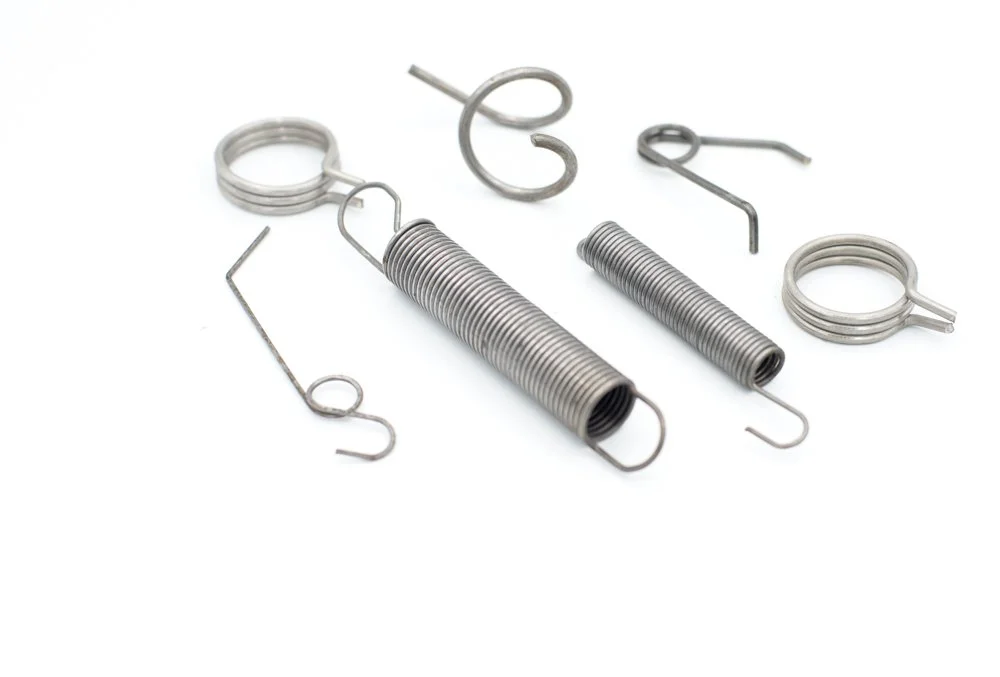
Compression Springs
Compression springs resist compressive force. They are common in valves, actuators, mechanical assemblies, shock absorbers, and general load-bearing applications. You can also find them in your LaZBoy.
Compression spring variations include straight, conical, barrel, tapered, hourglass, or custom-coiling.
Extension Springs
Extension springs are designed to absorb and store energy under tension. They are used in garage door mechanisms, linkages, retracting mechanisms, toys, and more.
Torsion Springs
When rotational torque is needed, torsion springs are used. They are key in hinges, lever returns, clock motors, and rotational assemblies.
Wire Forms, Clips & Custom Shapes
Beyond classic springs, many designs require bent wire, clips, brackets, or specialty forms — or wire forms. Wire forming capabilities enable bending, looping, stamping, and shaping to integrate directly into assemblies.
Flat Springs & Specialty Geometries
In tight spaces or precision devices, flat leaf springs, disc springs, or constant force springs may be preferred.
By offering all these capabilities, Tennessee Spring & Metal can serve as a one-stop solution for your spring and metal forming needs.
Chapter 4: Materials & Wire Choices
One of the first decisions in a custom spring project is choosing the right material. The choice affects strength, fatigue properties, corrosion resistance, temperature performance, cost, and more. Some common materials include:
High-carbon steel (oil-tempered, music wire)
Chrome-silicon or chrome-vanadium
Stainless steels (e.g. 300-series, 17-7PH)
Nickel alloys (Inconel®, Hastelloy)
Copper alloys (phosphor bronze, beryllium copper)
Specialty alloys (e.g. Elgiloy, titanium)
Tennessee Spring & Metal is capable of working with fine wires as thin as 0.008″ up to heavy gauge up to 0.625″ for springs.
Learn more about “Choosing the Right Metal Spring Material for Your Application.”
Key selection factors:
Load vs. deflection requirements – stiffer materials allow stronger load in smaller wire
Fatigue life – some alloys resist fatigue better
Environmental resistance – stainless, nickel, or coatings help against corrosion
Temperature range – high-temperature environments often require specialized alloys
Cost & availability
Often, engineers collaborate in early design stages to simulate stress, deflection, and life cycle performance to pick the optimal material.
Chapter 5: Six Design Considerations & Engineering Collaboration
To turn your concept into a practical, manufacturable spring, several design considerations must be addressed:
#1: Load-Deflection Curve & Spring Rate
Define how much force is needed per unit deflection. This helps determine wire diameter, coil size, and pitch. The engineer ensures the coil does not saturate or yield prematurely.
#2: Geometric Constraints
Inner diameter, outer diameter, free height, and solid height all need to fit within your mechanical assembly. End types (ground, squared, reduced, closed, open) and hand (left or right wound) may also be specified.
#3: Fatigue & Life
If your design is subject to many cycles, fatigue is critical. Consider stress-relieving, shot peening, or other methods to improve life.
#4: Hook/End Types & Fixing Methods
For extension springs or torsion springs, the hook, loop, lug, or tab geometry is important for integration into your system.
#5: Tolerance & Testing
How tight must your tolerances be? What variation is acceptable? This impacts manufacturability and inspection.
#6: Value Engineering
Our team may suggest ways to reduce cost or improve manufacturability based on our customers specifications and information. For example, we may recommend slight changes in geometry that reduce scrap, reduce material usage, or ease assembly and improve performance.
At Tennessee Spring & Metal, we provide in-house engineering support to partner with customers on optimization, value engineering, and manufacturability.
Chapter 6: Manufacturing Processes & Capabilities
Once the design is finalized, custom spring fabrication enters the manufacturing phase. Key capabilities and methods include:
Spring Coiling / Wire Coiling
Precision coiling machines wind wire to create the body of compression, extension, or torsion springs. Modern CNC or servo-driven spring coilers allow tight tolerances and complex geometries.
Wire Forming & Bending
Wire bending or forming use CNC or specialized machinery to shape wire into desired clips, forms, or assemblies.
Di-Acro Metal Fabrication / Precision Forming
Tennessee Spring & Metal offers Di-Acro metal forming and FluidForming sheet metal forming processes to handle sheet, strip, or formed components alongside spring work.
Stress Relieving & Heat Treatment
After forming, springs often undergo heat treatment or stress relief to stabilize their shape, reduce residual stresses, and improve consistency.
Grinding & End Processing
For compression springs, ends are often ground flat. Other finishing operations — e.g., colds setting or shot peening — may be done to improve linearity or fatigue.
Secondary Operations
These include co-assembly, kitting, packaging, labeling, and inventory management. Having these operations in-house helps reduce handing time and risk.
Because Tennessee Spring & Metal has a 34,000 square foot manufacturing facility near Nashville, we can support a wide volume range in-house and shipping is fast and cost-effective.
Chapter 7: Secondary Operations, Finishes & Testing
A key differentiator in custom spring fabrication is the breadth of finishing and validation services. Tennessee Spring & Metal provides many of these value-added steps, so you receive a near-ready component.
Check out our Guide to Custom Spring Coatings and discover some of the benefits of our custom spring manufacturing services.
Surface Coatings & Plating
Galvanizing
Electrocoating (e-coat)
Powder coating
Enameling
Plating (zinc, nickel, etc.)
Permanent lubrication / Teflon coating
These coatings enhance corrosion resistance, reduce friction, and improve durability.
Testing & Validation
Quality testing is the name of the custom spring fabrication game!
Salt spray / corrosion testing
Load testing & deflection testing
Fatigue testing
Dimensional inspection / metrology
Packaging, Kitting & Inventory
The spring shop can handle packaging, labeling, barcoding, and even consigned inventory or just-in-time (JIT) inventory models. This reduces your internal handling and supply-chain complexity.
Chapter 8: Quality Assurance, Traceability & Certifications
One of the most critical aspects of custom spring fabrication is ensuring consistent quality, documenting it, and maintaining traceability. Tennessee Spring & Metal maintains:
ISO 9001:2015 quality management certification
AS9100 Rev D (for aerospace / defense compliance)
ITAR Registration
Full material traceability (heat and lot numbers)
Calibration of inspection instruments
Internal audits, process controls, and statistical monitoring
Compliance with federal and industry standards
These systems help ensure that every batch meets the same rigorous standards and that if issues arise, they can be traced and corrected quickly.
Chapter 9: Tennessee Spring & Metal: Why Partner With Us
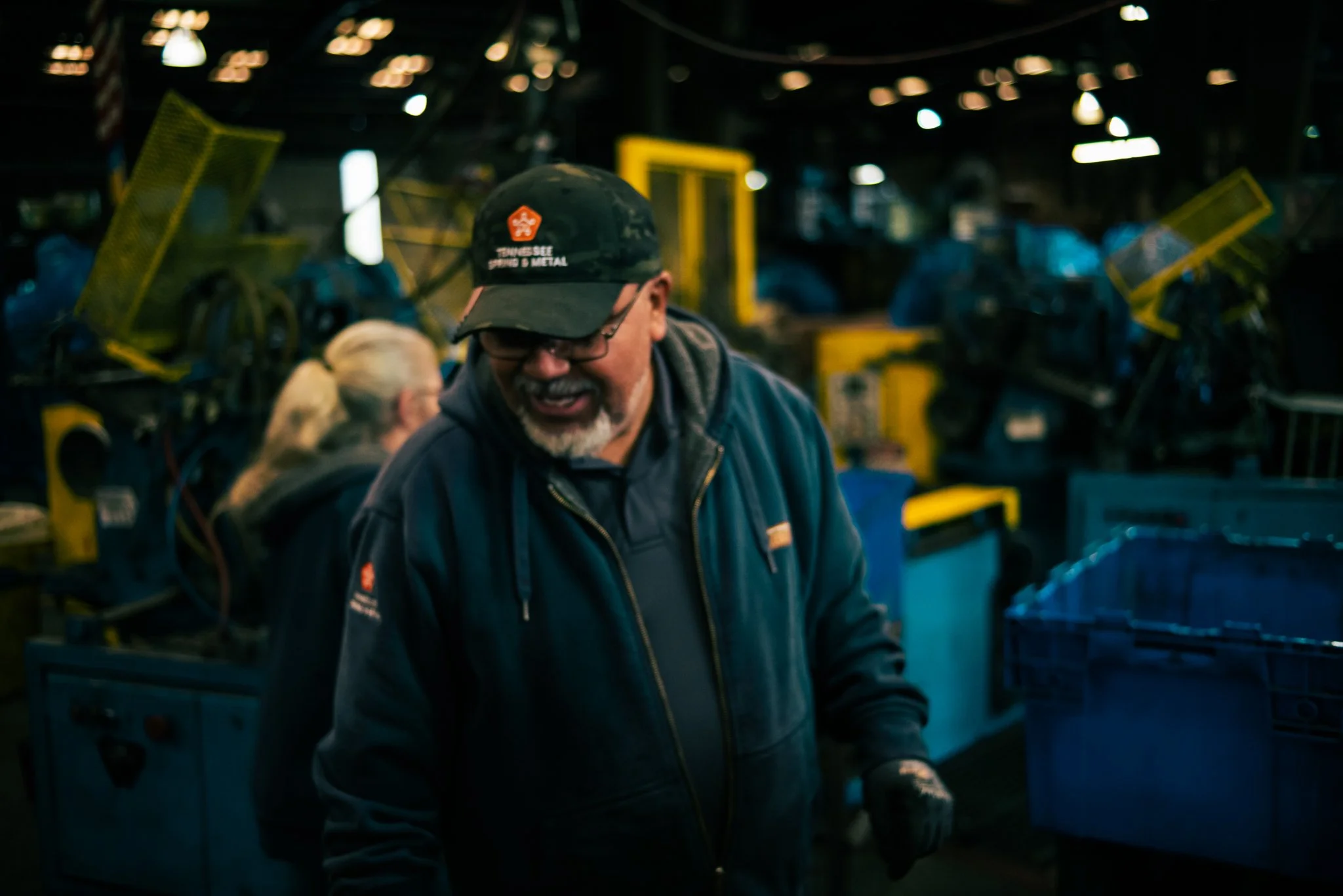
Beyond our amazing personalities, here’s what distinguishes Tennessee Spring & Metal in the custom spring fabrication industry:
Deep Experience & Reputation: Serving manufacturers since 1963, with decades of accumulated spring design and fabrication knowledge.
Broad Capabilities: We produce compression, extension, torsion springs — from fine wire (down to 0.008″) to heavy gauge (up to 0.625″).
Integrated Metal Forming: In addition to springs, we support wire forms, clips, and metal formed parts — reducing assembly complexity.
Value-Added Services: In-house coating, plating, testing, packaging, inventory management — a one-stop solution.
Quality & Certifications: ISO 9001:2015, AS9100 Rev D, rigorous traceability, calibration, audits.
Proximate Location: Based near Nashville, Tennessee in a 34,000 ft² facility — conveniently serving North America.
Customer-Centric Approach: Engineering support, collaborative design, value engineering, and a consultative mindset to solve spring challenges.
Because of these strengths, our customers across industrial doors manufactureres, automotive, medical, agricultural, HVAC, and general industrial sectors rely on Tennessee Spring & Metal for reliable custom spring fabrication.
11. How to Request a Custom Spring Quote
To request a quote and start a custom spring project, follow these steps for a smoother quoting process:
Gather specifications
Type of spring (compression, extension, torsion, wire form)
Performance requirements: force vs displacement, torque, number of cycles
Physical constraints: inner/outer diameters, free/solid height, total length
End types, hooks, lugs, loops
Material preferences or constraints
Environmental conditions: temperature, corrosion, fatigue
Finish or coating requirements
Required tolerances
Provide drawings or sketches (CAD or engineering sketches)
Specify quantity / volume expectations
Target timeline / lead time constraints
Quality or traceability requirements (certifications, inspection, lot trace)
Special constraints (e.g. weight, assembly fit, regulatory compliance)
Once you submit that information — you can do it online! — our team reviews the requirements, asks clarifying questions, and provides a quote. We’ll often include suggested refinements or cost-saving options.
Chapter 12: Frequently Asked Questions (FAQs)
Get all your questions answer right here or check out this expanded FAQ post on our website!
Q: What is the minimum wire size you can work with?
A: Tennessee Spring & Metal works with fine wire as thin as 0.008″.
Q: What is the thickest wire diameter you can handle?
A: Up to 0.625″ for heavier springs.
Q: Can you handle both small prototype runs and high-volume production?
A: Yes — the facility and processes support both small and large runs.
Q: Do you offer coating, plating, or finishing services?
A: Yes — including galvanizing, electrocoating, powder coat, enameling, permanent lubricant, Teflon, and more.
Q: What certifications do you maintain?
A: Tennessee Spring & Metal is ISO 9001:2015 and AS9100 Rev D certified and ITAR Registered.
Q: How long does it take to get a custom spring quote and production?
A: It depends on complexity, but our review is generally prompt. Lead times vary based on requirements, materials, and finishing, but integrated operations help keep timelines tight.
Q: Can you assist with spring optimization or value engineering?
A: Yes — they provide in-house engineering support to suggest optimizations, cost reduction, or alternate geometries.
If you’re ready to elevate your products with high-quality, precisely engineered springs, reach out to Tennessee Spring & Metal today for a quote and get started on your next custom spring project.
About the author: As CEO of Tennessee Spring & Metal, Paul Benny works closely with business owners, CEOs, manufacturers, product designers, engineers, and inventors to help them produce the most innovative, durable, and precision-driven products in today’s marketplace. Tennessee Spring & Metal makes standard and custom metal springs to exacting specifications. And we've been doing it since 1963. For springs Made in America from 100% traceable wire, you can count on us. Learn more about our custom metal spring quoting process today.